
From the plantation to your cup.
Seven steps, one bag of beans. Here is the whole trace of a Taproot roast — where our coffee grows, who picks it, how it is dried, milled, roasted and finally brewed. Nothing hidden, nothing blended away.
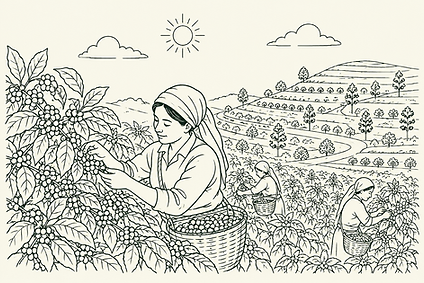
Planted
Our beans grow with smallholder farms in Chikmagalur and the Baba Budangiri hills, between 1,100 and 1,500 metres. Arabica and robusta are planted under silver oak and rosewood shade, where the slow, cool ripening builds sweetness into every cherry.

Hand-picked
Harvest runs from November to January. Pickers walk the rows every ten days and take only the fully ripe, deep-red cherries by hand — the green ones and the dried ones stay on the branch. One tree gives us roughly two kilos of fruit a season.
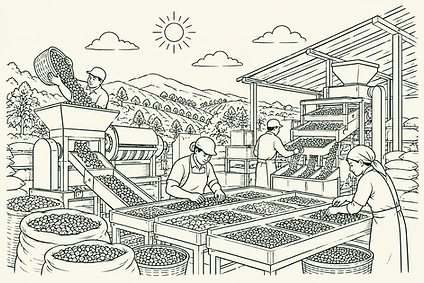
Processed & dried
The same day, cherries are pulped and the beans ferment in tanks for 24 to 36 hours before washing clean in spring water. Then they dry slowly on raised beds for about twelve days, raked by hand, until moisture drops to eleven percent.


Milled & graded
Dried beans rest in parchment for a month, then go to the mill: hulled, sized through screens and picked over by hand for defects. What survives is green coffee — weighed, graded and sealed in jute for the road to Bengaluru.

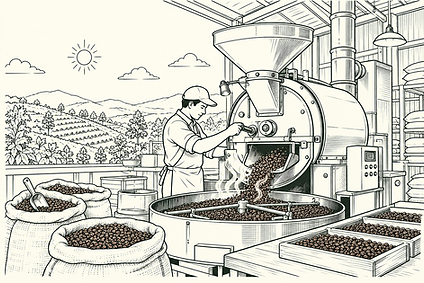
Roasted in small batches
Our drum roaster works in twelve-kilo batches. Every lot gets its own profile — charge temperature, airflow, the exact moment of first crack at around 196°C — and each roast is cupped before it is allowed anywhere near a grinder.

Ground & brewed
Beans rest three to seven days, then are ground to suit the brew: coarse for pour-over, fine for the filter, in between for espresso. Brew water sits at 92 to 94°C, and every shot is weighed and timed.


Your cup
Poured, sipped, and — if you are sitting at the bar — argued about. Chaff and spent grounds go back to the garden beds outside, and the whole thing starts again with next season's cherries.

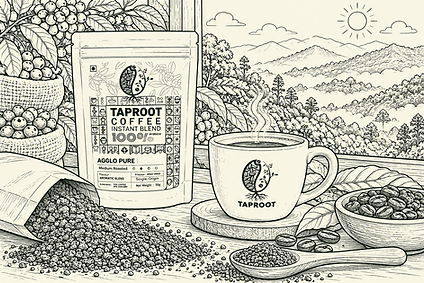
Come taste where it comes from.
Every bag on our shelves carries the same trace, from the farm gate to the grinder. Order a bag for the kitchen at home, or take the long way round and ask us about the lot on the bar this week.